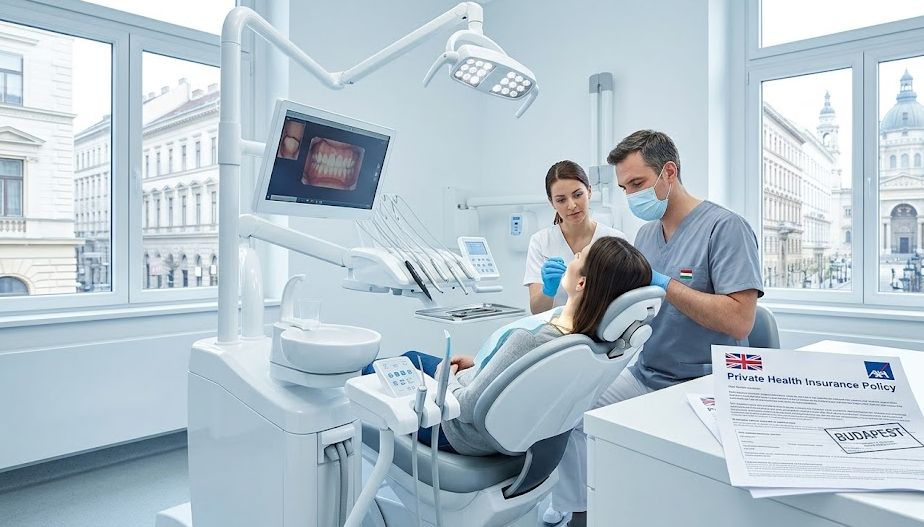
You can often use UK private health insurance such as Bupa or AXA to claim back part of the cost of dental work carried out in Budapest, but it usually works on a reimbursement basis rather than the Hungarian clinic billing your insurer directly. The key is choosing the right policy, understanding what dental treatments are covered, and making sure your Budapest dentist provides invoices and clinical documents in clear, insurer‑friendly English.
Why UK Insurers Cover Dental Work Abroad
Most mid‑ to high‑tier UK private medical and dental plans from Bupa and AXA include some form of cover for treatment outside the UK, especially if it is medically necessary or falls under emergency care. Some international or “worldwide” plans explicitly state that treatment within your plan limits is covered both at home and abroad, including in EU countries such as Hungary.
However, the structure of cover differs:
-
Standard UK domestic dental add‑ons (e.g. Bupa Dental, AXA Dental) primarily focus on treatment within the UK and at approved partner clinics, with only limited overseas emergency benefits.
-
International private health insurance (e.g. Bupa Global, AXA Global Healthcare) is designed for expats and frequent travellers, and more readily reimburses planned treatment abroad, within annual limits and subject to pre‑authorisation.
For dental tourism to Budapest, UK residents typically pay the Hungarian clinic themselves in local currency, then submit a claim to Bupa or AXA when they return home.
Reimbursement Basics: How It Works
With UK private health insurers, dental work in Budapest is almost always handled via reimbursement rather than direct settlement. This means:
-
You book and pay for your dental treatment at a Hungarian clinic of your choice (private provider, not part of Hungarian state insurance).
-
You collect all invoices, receipts, and medical documentation in English (or bilingual Hungarian–English).
-
You submit these documents to your insurer (online portal or postal claim form) within their specified deadline.
-
The insurer assesses the claim, applies any policy limits, deductibles, co‑payments, and waiting periods, then reimburses you up to your coverage cap.
Many Bupa and AXA products include worldwide emergency dental benefits, but planned large treatments (implants, full mouth rehab, cosmetic work) often require pre‑authorisation before you travel.
Typical Coverage: What Bupa and AXA Pay For
Dental cover through UK insurers splits into routine, restorative, and emergency categories. Budapest clinics offer all of these, but your insurer may not reimburse every type of treatment.
Routine and Preventive Care
Routine dental benefits usually include:
-
Check‑ups and consultations.
-
X‑rays (bitewing, panoramic).
-
Hygienist visits, scale and polish.
Bupa dental plans are particularly strong on preventive cover at Bupa‑accredited UK practices, reimbursing 100% of preventive costs in‑network. Overseas, these benefits may be capped or treated as “out‑of‑network” reimbursement with fixed maximums per visit. AXA dental plans cover routine treatment with percentage‑based reimbursement and annual limits, sometimes with a short waiting period for new members.
Restorative and Surgical Treatments
Restorative benefits, which are especially relevant for dental tourism in Budapest, typically include:
-
Fillings, root canal treatments, extractions.
-
Crowns, bridges, and some prosthodontics.
-
Periodontal therapy for gum disease.
AXA Premium, for example, offers broader restorative coverage and even a limited sub‑limit for dental implants (e.g. £500 towards implants in some tiers), though implants for age‑related tooth loss are often excluded. Bupa tends not to include implants as standard in its dental policies, and may classify them as elective or cosmetic in many plans.
Emergency Dental Care Abroad
Both Bupa and AXA commonly include worldwide emergency dental care, which is useful if you develop acute pain or infection while in Hungary. Examples of covered emergency treatments include:
-
Urgent pain relief, temporary fillings.
-
Incision and drainage for abscess.
-
Emergency extractions.
Coverage is normally limited to stabilising the condition, not completing long‑term cosmetic work.
Common Exclusions and Limitations
Not every Budapest dental treatment will be reimbursed. UK insurers typically exclude or restrict:
-
Purely cosmetic work (teeth whitening, veneers for appearance only).
-
Implants and complex prosthetics beyond stated sub‑limits.
-
Orthodontics for adults unless specifically covered.
-
Treatments for pre‑existing conditions without appropriate waiting periods.
Bupa often imposes waiting periods for routine and some restorative treatments (for example, two months for routine and four months for specific restorative benefits). AXA has similar waiting periods depending on plan tier, plus co‑payments and annual caps.
If your Budapest treatment plan focuses on cosmetic smile design, full veneers, or elective implants, you should assume most of the cost will be self‑funded, with only limited reimbursement for medically necessary components (e.g. extractions, bone grafts due to pathology) where your policy allows.
Pre‑Authorisation: Why It Matters Before You Fly
For high‑value courses of treatment, Bupa and AXA often require pre‑authorisation, especially under international plans. Pre‑authorisation means sending them your Budapest treatment plan before you start work.
A good pre‑authorisation pack should include:
-
A written treatment plan from the Hungarian clinic, in English, listing each procedure, tooth numbers, materials, and estimated costs.
-
Diagnostic documents: x‑ray report, photos, or CBCT summary where relevant, with brief English notes.
-
Clinical justification: explanation of why treatment is medically necessary (e.g. severe decay, infection, functional bite problems) rather than purely cosmetic.
The insurer then confirms what they will reimburse, under which benefit category, and up to what limit, giving you clarity before you travel.
Essential Paperwork from a Budapest Dental Clinic
To ensure smooth reimbursement from Bupa or AXA, ask your chosen Budapest clinic to follow a “UK insurer‑ready” documentation structure. Many reputable dental tourism providers in Hungary are familiar with international patients and can prepare paperwork accordingly.
1. Detailed English Invoice
Your invoice should be either fully in English or bilingual Hungarian–English, with:
-
Patient full name, date of birth, and address.
-
Clinic name, address, phone, email, and tax number.
-
Date(s) of treatment and date of invoice.
-
Itemised list of each procedure with clear English descriptions (e.g. “root canal treatment, tooth 36”; “zirconia crown, tooth 11”).
-
Individual prices per item and total amount paid, including currency (HUF or EUR) and VAT status.
-
Payment confirmation note (e.g. “Paid in full by card on [date]”).
Insurers normally require original invoices or high‑quality scans showing that you have already paid these amounts.
2. Receipt and Proof of Payment
Alongside the invoice, you should retain:
-
Card terminal receipt or bank transfer confirmation.
-
Any online payment acknowledgements.
UK reimbursement processes (including NHS cross‑border refund procedures) emphasise keeping all receipts and proof of payment for treatment abroad.
3. Clinical Report in English
For larger courses of treatment, a concise English clinical report makes your claim much easier to process. This document should cover:
-
Diagnosis: caries, periodontitis, missing teeth, fracture, etc.
-
Treatment performed: list of procedures with dates.
-
Prognosis and follow‑up: expected outcome, need for future maintenance.
Hungarian dentists often provide these reports for international patients, especially in clinics that regularly treat British and other EU visitors. A clear report helps your insurer classify each item into routine, restorative, or emergency categories.
4. Radiological and Imaging Evidence
Radiographs (x‑rays) and CBCT scans are helpful for pre‑authorisation or complex claims. They do not have to be translated word‑for‑word, but a short English summary or letter from the dentist interpreting the images is recommended.
5. Clinic Stamp and Signature
Insurers prefer documents to be signed by the treating dentist and stamped with the clinic’s official seal. This confirms authenticity and helps prevent delays or supplementary questions during claims processing.
Language Requirements: Why English Matters
Although Hungarian is the official language in Budapest, English is widely used in private dental clinics serving international patients. For UK insurers, English documentation is strongly preferred because:
-
Claims teams are based in the UK and rely on English‑language descriptions to classify benefits correctly.
-
Misinterpretations from literal translation of Hungarian procedure names can lead to partial denial or querying of your claim.
Most high‑end Budapest clinics already issue invoices and medical reports in English or can do so on request, making them ideal for British dental tourists seeking reimbursement from Bupa or AXA.
Claim Submission: Practical Steps for UK Policyholders
Once you return to the UK (or even while still in Budapest), you can submit your claim through your insurer’s usual channels. Standard best practice includes:
-
Register or log in to your online member portal (Bupa, AXA).
-
Complete the claim form with details of the provider, country (Hungary), dates, and type of treatment.
-
Upload or attach scanned copies of invoices, receipts, and clinical documents in English.nhsbsa.
-
Keep originals in case the insurer requests them.
-
Monitor your claim status and respond promptly to any requests for additional information.
Insurers usually reimburse within a few weeks, depending on internal assessment times and whether they need clinical review for large restorative or implant claims.
Limits, Co‑Payments, and Exchange Rates
When planning dental tourism to Budapest with UK insurance reimbursement, pay attention to financial mechanics within your policy:
-
Annual dental limits: Many plans cap total dental benefits per policy year; high‑end treatments like full mouth rehabilitation can hit this limit quickly.
-
Percentage reimbursement and co‑payments: Insurers may only reimburse 50–80% of certain treatments, leaving you to fund the remainder.
-
Deductibles or excess: Some policies include an excess that you must pay before benefits apply.
-
Exchange rates: Refunds are typically calculated based on official or internal exchange rates at the time of payment or claim processing.
UK NHS guidance on claiming refunds for medically necessary treatment abroad confirms that charges will be refunded according to the rules and rates of the country where treatment was received, adjusted by EU‑provided exchange rates. Private insurers follow similar internal logic, converting your Budapest invoices from HUF/EUR to GBP before reimbursement.
Budapest as a Dental Tourism Hub
Budapest is one of Europe’s leading dental tourism destinations, known for high‑quality treatment, competitive pricing, and English‑speaking staff. Modern clinics offer state‑of‑the‑art equipment, implants, cosmetic dentistry, and comprehensive treatment plans tailored to international patients.
For UK policyholders, Budapest combines:
-
Lower procedure costs than typical UK private clinics, especially for crowns, implants, and cosmetic dentistry.
-
EU‑level clinical standards and materials.
-
Familiarity with international paperwork, making it easier to claim reimbursement from insurers such as Bupa and AXA.
This makes Budapest attractive not only for self‑funded dental tourists but also for those aiming to recover part of their costs via UK private insurance.
Practical Tips for Maximising Reimbursement
To optimise your chances of successful reimbursement for Budapest dental work under UK private health insurance, consider these practical steps:
-
Check your policy wording in detail before booking, focusing on sections on “dental benefits”, “overseas treatment”, “emergency dental abroad”, and “exclusions”.
-
Ask your insurer whether planned Budapest treatment needs pre‑authorisation, especially if it involves implants, extensive crowns, or surgery.
-
Choose a well‑established Budapest clinic that regularly treats UK or international patients and is willing to issue detailed English documentation.
-
Request a written treatment plan in English with costs before committing, and send it to your insurer for a coverage check.
-
Keep every receipt and invoice, and ensure they clearly state that payment has been made; missing proof of payment can block reimbursement.
Summary for UK Dental Tourists
For UK residents with private health insurance (Bupa, AXA), dental treatment in Budapest can be partially reimbursable, provided it fits your policy’s dental and overseas treatment rules. Routine check‑ups, restorative work (fillings, root canals, crowns), and emergency dental care abroad are often covered up to annual limits, while implants and purely cosmetic procedures face tighter restrictions or sub‑limits.
Budapest dental clinics used to working with foreign patients will supply English or bilingual invoices, itemised procedures, and clinical reports that satisfy UK claims teams. You pay the clinic directly, keep all original invoices and receipts, and then submit a claim to Bupa or AXA for reimbursement, with final payment in GBP after the insurer applies its benefit caps and exchange rates.
If you plan a complex smile makeover or implant‑heavy reconstruction in Budapest from the UK, always check your insurance policy first and secure pre‑authorisation where necessary, so you know exactly how much of your Hungarian dental bill will be reimbursed once you return home.
FAQ – UK Private Health Insurance and Dental Work in Budapest
1. Can I use my UK private health insurance (Bupa, AXA) to pay for dental work in Budapest?
In most cases, Bupa and AXA will not pay the clinic directly in Budapest, but they may reimburse part of your dental costs after you return home, depending on your specific policy. You typically pay the Hungarian dentist yourself, then submit invoices and medical documents in English to your insurer for assessment and possible refund. Always check your policy’s dental and overseas treatment sections before booking.
2. Does Bupa cover planned dental treatment abroad, or only emergencies?
Standard Bupa dental plans tend to focus on UK treatment, with limited benefits for dental emergencies abroad. Some comprehensive or international policies may cover planned dental treatment overseas if it is medically necessary and pre‑authorised. Cosmetic work, elective implants, and purely aesthetic smile makeovers are usually excluded or only partially covered. Review your policy wording and seek written confirmation from Bupa before scheduling major work in Budapest.
3. Does AXA reimburse dental treatment carried out in Hungary?
AXA’s dental and health insurance products often include emergency dental cover abroad and, in some tiers, partial reimbursement for planned treatment outside the UK. Whether your Budapest treatment is reimbursed depends on the plan type, annual dental limits, waiting periods, and whether procedures are classed as routine, restorative, or cosmetic. Contact AXA with your proposed treatment plan from the Hungarian clinic to clarify exactly what they would pay.
4. What kind of dental treatments are usually covered by UK private insurance abroad?
UK private insurers are more likely to cover medically necessary treatments such as fillings, root canals, extractions, crowns, bridges, and emergency pain relief or infection control. Routine check‑ups and hygiene may also be covered, though often at lower limits if performed outside the UK. Cosmetic treatments (whitening, veneers for purely aesthetic reasons) and elective implants are frequently restricted, excluded, or subject to small sub‑limits. Your reimbursement will depend on how your insurer classifies each procedure.
5. What documentation should a Budapest dental clinic provide for Bupa or AXA reimbursement?
For smooth reimbursement, ask your Budapest clinic to prepare:
-
A detailed invoice in English or bilingual Hungarian–English.
-
Itemised list of each treatment with tooth numbers, materials, and prices.
-
Proof of payment (card receipt, bank transfer confirmation).
-
A brief clinical report in English explaining diagnosis and treatment.
-
Signed and stamped documents with clinic address and tax number.
This information helps your insurer verify what was done, why it was needed, and how much you paid, so they can apply the correct benefits under your policy.
6. Do invoices and reports have to be in English?
English documentation is strongly recommended, because Bupa and AXA claims teams work in English and need clear descriptions to classify treatments correctly. Many Budapest clinics serving international patients routinely issue invoices and clinical reports in English or bilingual format. If you receive documents only in Hungarian, your insurer may ask for translations, which can delay or complicate the claim.
7. How does the reimbursement process work in practice?
The typical process for UK policyholders is:
-
You pay the Budapest clinic directly for your dental treatment.
-
The clinic issues English or bilingual invoices and a clinical report.
-
You submit a claim through your insurer’s online portal or claim form, attaching scans of all documents.
-
The insurer reviews the claim, converts the amount into GBP at its internal exchange rate, and applies policy limits, co‑payments, and exclusions.
-
Any approved amount is reimbursed to your bank account.
Time frames vary, but most claims are processed within a few weeks if all documents are clear and complete.
8. Do I need pre‑authorisation from Bupa or AXA before starting dental work in Budapest?
For high‑value treatment plans such as full mouth rehabilitation, implant surgery, or multiple crowns and bridges, pre‑authorisation is highly advisable and sometimes mandatory. You would normally send your proposed treatment plan, x‑rays, and cost estimate from the Budapest clinic to your insurer for review. They then confirm what will be covered, under which benefit categories, and up to what amount, so you have clarity before committing to the treatment.
9. Are dental implants in Budapest covered by UK private health insurance?
Implant coverage is one of the most restrictive areas. Many standard dental policies exclude implants entirely or only reimburse a small contribution towards medically necessary implant‑supported restorations. Cosmetic or elective implants are usually not covered. If implants are central to your Budapest treatment, assume you will self‑fund most of the cost and treat any reimbursement as a bonus rather than a guarantee.
10. How do exchange rates affect my reimbursement?
Your invoices from Budapest will usually be issued in Hungarian forint (HUF) or sometimes in euro (EUR). When you submit your claim, your insurer converts these amounts to British pounds (GBP) using either official or internal exchange rates valid at the time of assessment. This means the final refunded amount in GBP may be slightly higher or lower than what you expect based on tourist exchange rates, and will also be reduced by any limits, co‑payments, or excess stated in your policy.
11. Can Italian‑based UK expats use UK private insurance for Budapest dental treatment?
If you are a UK national living in Italy with an active UK private health insurance or international plan, your ability to claim for Budapest dental treatment will depend on your residency rules and whether your policy is still valid for you as an expat. Many international policies cover treatment across multiple countries, including Hungary, but domestic UK products may have restrictions. Check directly with your insurer, explain your situation, and send them your Budapest treatment plan for a personalised answer.
12. What are the biggest mistakes UK dental tourists make when trying to claim reimbursement?
Common pitfalls include:
-
Not reading the policy’s overseas and dental sections in detail.
-
Assuming cosmetic or implant‑heavy treatment will be fully covered.
-
Failing to request English invoices and clinical reports from the clinic.
-
Starting expensive work without pre‑authorisation for large treatment plans.
-
Losing receipts or proof of payment, making it harder to evidence the claim.
Avoid these mistakes by planning ahead with both your insurer and your chosen Budapest clinic.
Sources
- Bupa Global – Private health insurance and worldwide cover information: https://www.bupaglobal.com/en/private-health-insurance/gb
- Bupa UK – Health insurance overview: https://www.bupa.co.uk/health/health-insurance
- AXA Global Healthcare – International health insurance: https://www.axaglobalhealthcare.com/en/
- AXA vs Bupa dental insurance comparison (UK, 2026): https://www.dentalplanfinder.co.uk/compare/bupa-vs-axa
- NHS Business Services Authority – Claim a refund for treatment costs abroad: https://www.nhsbsa.nhs.uk/claim-refund-treatment-costs
- Helvetic Clinics – Dental trip to Budapest (example of international‑focused Hungarian clinic): https://www.helvetic-clinics.co.uk/budapest/
- General guidance on overseas dental reimbursement and documentation (Hungary/US example): https://www.thehungarypage.com/us-dental-coverage/